
Service Area
Preconstruction
Office
Buildings
Permitting
Delivery
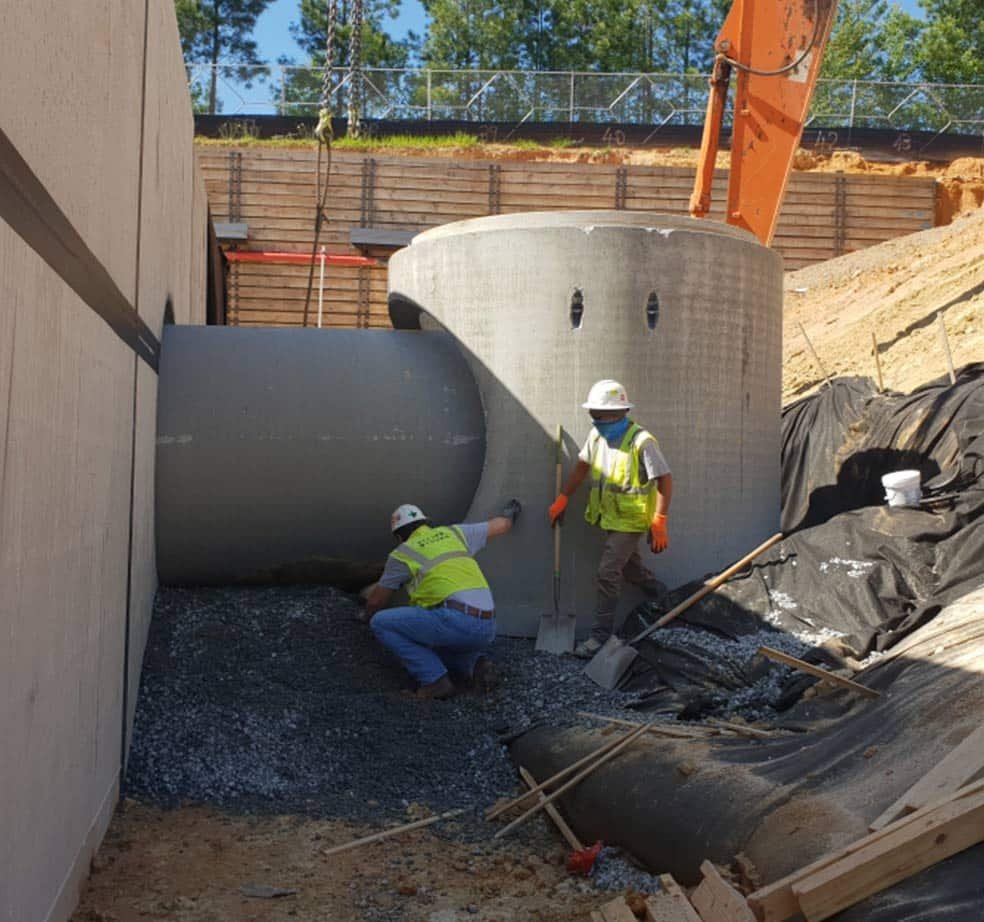
Nearly every building in Edinburg that fails to open on time was delayed first by something in the ground, whether a drainage outfall that had to be rebuilt, a water line that had to be extended or a pad that had to be raised. Site development is the work that makes a parcel ready for a building, and it covers clearing, grading, stormwater, paving, utilities and the permits that go with them. We treat it as the first critical path on a project, not as a preliminary task.
The flat terrain of Hidalgo County makes water the dominant concern. The National Weather Service Brownsville recorded 9.78 inches of rain two miles north of Edinburg during Hurricane Hanna in July 2020 and reported 18 inches to up to 4 feet of standing water where drainage was poor, including areas east of Edinburg. A site plan that moves water away from the building and into a legal outfall is the foundation of everything that follows.
The drainage system around Edinburg
Hidalgo County Drainage District No. 1 was reported in October 2025, in coverage of the State of the County address, to have completed over 330 miles of drainage improvements and added 656 acres of detention capacity, improving drainage for more than 659 square miles. The district's North Main Drain expansion in Edinburg, a $7 million ditch widening that broke ground in July 2023, was reported in 2024 as a measure that could help keep floodwaters out of neighborhoods, and a proposed $33 million project would widen about 15 miles of the same drain.
These improvements matter to site designers because they change the available outfalls and the assumptions behind detention requirements. We ask the district and the city which outfalls serve a parcel and which conditions apply, instead of relying on old maps.
The sequence of site work
Work begins with a survey, a geotechnical investigation and a stormwater plan. We then clear, strip topsoil, install erosion controls, rough grade and bring in structural fill where the pad must be raised. Utilities are installed next, including storm drains, sanitary sewer, water mains, fire lines and conduit, followed by subgrade preparation, curb, base and paving.
Underground utilities should be inspected and accepted before they are covered. We schedule inspections with the city and with utility providers in advance, and we keep as-built records of every line, since errors discovered later require excavation of finished paving. Truck courts and dock aprons are discussed on our pages for distribution centers and warehouses.
Permits, floodplain rules and inspections
The City of Edinburg Building Safety Department is the contact for permits and inspections within the city, with an online self-service portal. Outside city limits, Hidalgo County's floodplain regulations require a Development Permit, and the posted version states a $50 fee for administrative reviews and field inspections in areas of special flood hazard. Because the posted copy leaves its adoption date blank, we confirm the current order with the county.
New commercial, industrial or other nonresidential construction in unincorporated areas must have its lowest floor at or above the base flood level or be floodproofed with an engineer's or architect's certification. We take this into account when we set pad elevations, which are the first numbers in the design that affect every other cost.
Site conditions that affect cost
Soils in the Valley can be clay-heavy, and wet clay will not support equipment or hold compaction. We schedule earthwork for dry periods where possible, and we provide haul roads and dewatering for the periods when it cannot be done. Texas Public Radio reported in March 2025 that storms dropped more than half a year's worth of rain on the region in 48 hours, so owners should plan for an interruption of days or weeks in some seasons.
Utility availability is the other major condition. Some parcels have service at the property line and others need extensions across neighboring land. A trade report described a 1-million-gallon water tower on North Business Highway 281 in North Edinburg, a project over $5 million with $2.1 million from the EDC, scheduled for completion in January 2025, which suggests investment in water service for the northern industrial area.
Starting before the building is designed
Site work is often released as an early package so that grading and utilities can proceed while the building design is completed. The approach saves time but requires the building location, floor elevation and utility entrances to be fixed early. We recommend confirming those items with the architect and the owner before mobilizing.
The design-build delivery and construction manager at risk methods both support early site packages, and public owners may release site work through a separate bid.
Where we prepare sites
We prepare sites in Edinburg, including the Edinburg North industrial park and the commercial parcels along the Trenton Road corridor, and in nearby communities in eastern Hidalgo County. Elsa sits on State Highway 107 and FM 88, about 11 miles east of Edinburg, and Drainage District No. 1 lists channel improvements near Elsa for Ditch 1.9, 2 and 4a at $23,010,000 for about 4.3 miles.
The conditions differ with each district and its ditch system, so we study the drainage authority for each parcel before pricing the work. A parcel near a major ditch may need a setback, an access easement for district maintenance equipment, or a design that leaves room for the future widening the district has proposed, and we raise these items with the owner before the site plan is drawn.
Get the ground right first
Send us a parcel and a use and we will report on drainage, utilities and review. Developers may also want the commercial real estate developers page for related background.
Questions Owners Ask
What does a site cost before the building starts?
It varies widely with the size of the parcel, the amount of fill, the paving and the distance to utilities. We provide a site estimate in preconstruction with each component separated, because the site often exceeds the first guess.
How do we keep rain from stopping the project?
We cannot prevent it, but we plan for it with erosion controls, positive drainage during construction, protected stockpiles and float in the schedule. We also schedule wet-sensitive operations such as subgrade stabilization for drier periods.
Do we need a geotechnical report before buying land?
It is advisable for any project that depends on foundation or paving cost. A report will show soil type, groundwater and fill requirements, and it can change the price of the land in the analysis.
Who pays for utility extensions?
It depends on the provider, the distance and the type of service. Some providers charge a fee or share cost, others require the developer to pay. We obtain written terms from each provider early.
Can site work be phased?
Yes. A large parcel can be prepared in phases, with roads, utilities and detention installed for the first phase and extended later. We plan the first phase so that later work does not disturb it.